
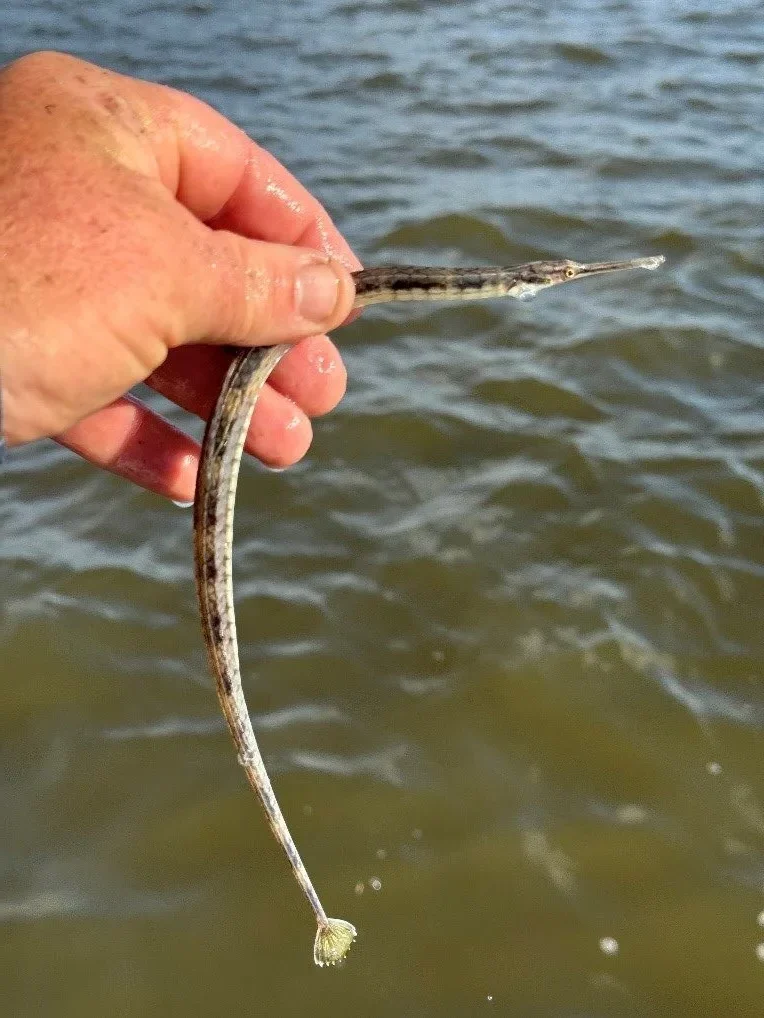
It’s always a bonus when sorting through the catch and you spot one out of the corner of your eye…a pipefish!
A close cousin to the seahorse, pipefish belong to the family Syngnathidae. Like seahorses, pipefish have fused jawbones and long tubular snouts adapted for feeding on small crustaceans. Their slender elongated bodies are also covered in specialized plates, giving them an armored, stiff appearance. Perhaps one of the most unique traits associated with this group of fishes is that they exhibit sex-role reversal; females deposit eggs into a specialized pouch on the male’s belly, where they are fertilized carried until the male gives birth to live young.
Pipefish are not likely to win any races based on their speed, but with their various color tones and patterns, they are well known for their ability to blend into their surroundings to avoid predators. Throughout much of their range they are often associated with submerged vegetation habitats such as seagrass beds. However, Georgia’s turbid coastal waters don’t support seagrasses. Instead, pipefish in our estuaries can be found around soft corals, sponges, seaweed, oyster beds and other bottom structures.
While they are not the only pipefish to call Georgia’s coast their home, the northern pipefish (Syngnathus fuscus) and chain pipefish (Syngnathus louisianae) are two of the most common species encountered on our sampling trips. Both have broad geographic ranges and are also known as euryhaline fish, which means they can thrive in a wide range of salinities from marine to freshwater conditions.