
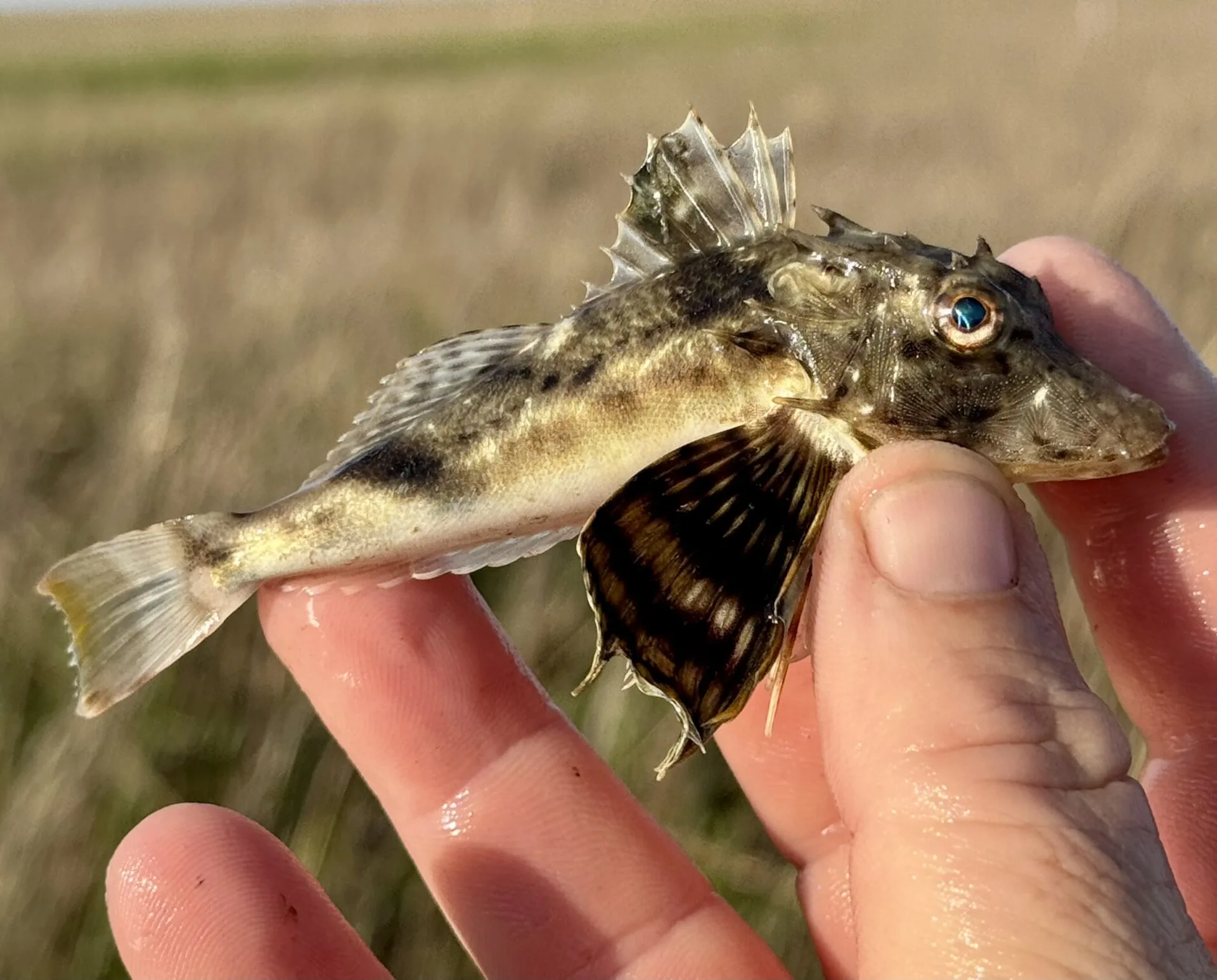
Did you know that the bighead searobin (Prionotus tribulus), which commonly occurs in Georgia’s estuaries is a relative of the venomous lionfish? Fortunately, while this unique-looking fish does have noticeable spines around its head and many of its fins for protection, it does not possess the potent venom that its cousin possesses!
Bighead searobins are actually one of several searobin species that inhabit Georgia’s coastal waters. Their large spiny head and squared off snout helps to distinguish them from other local searobins. They are grayish brown in color and have three distinctive dark bars on their upper bodies; underneath they are pale yellow to white. They also possess a dark blotch between their third and fourth dorsal spines. Their pectoral fins are brown with dark, irregular crossbars and their caudal fin has a single broad dark bar on it.
Members of the Triglidae family, sea robins in general are characterized by their bony-looking heads, elongated bodies and squared off (truncate) caudal fins. They get their names, however from their large, fan-shaped pectoral fins that often have various colors and patterns on them. Each pectoral fin has several detached fin rays along the front edge that allows them to “walk” on the sea floor. These specialized rays also help searobins sense prey such as mollusks, crustaceans and other bottom-dwelling marine life.
Fun fact: Searobins are known for the unique croaking noises they make (similar to a frog) which contributes to their other known name, gurnard.