
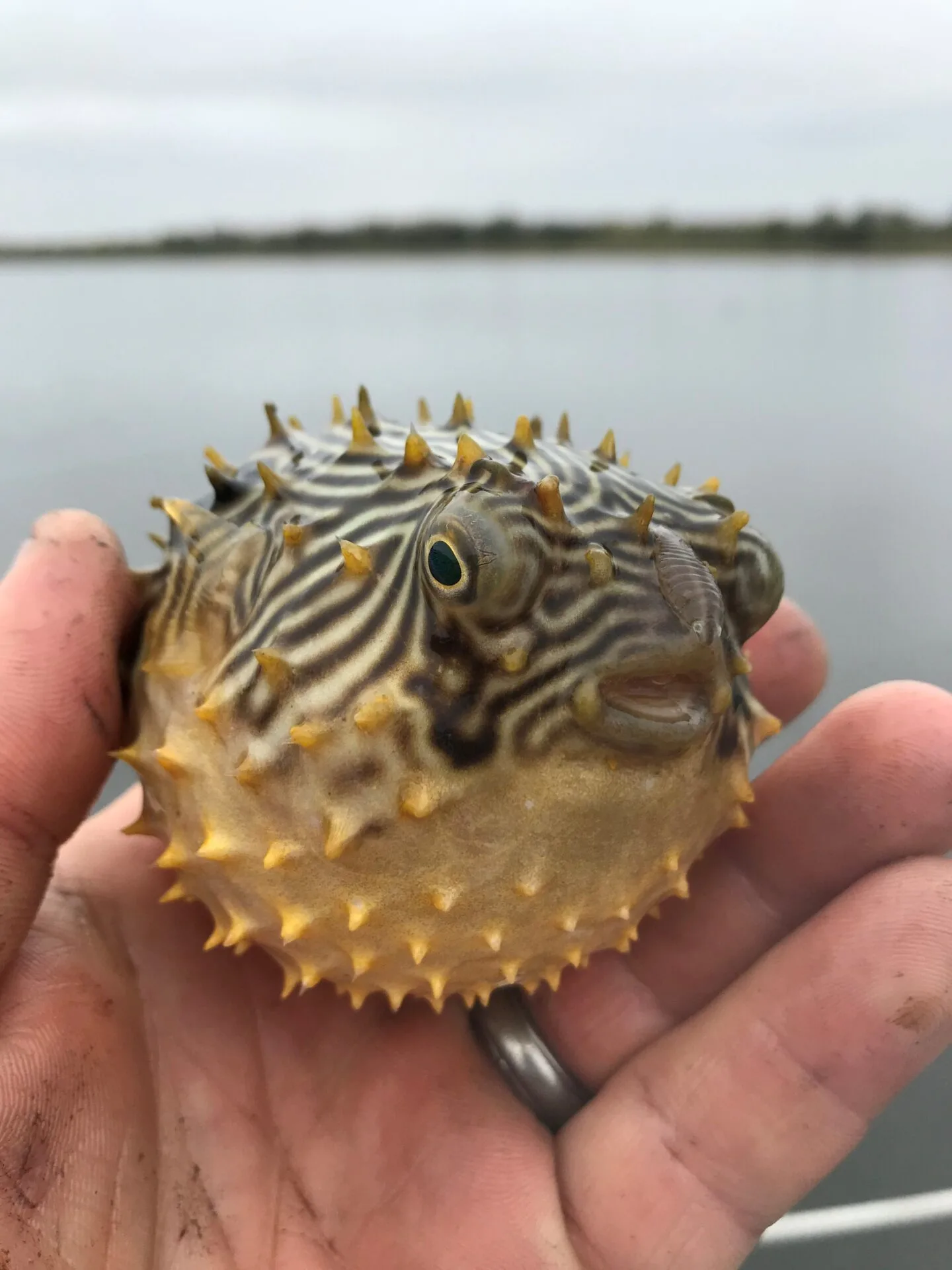
Always a crowd pleaser, the striped burrfish (Chilomycterus schoepfii) is no stranger to Georgia’s estuaries. A member of the porcupinefish family (Diodontidae), these prickly fish are easily recognized by their conspicuous stiff body spines, numerous wavy stripes and dark spots that cover their yellow-toned bodies. They also possess a parrot-like beak made up of fused teeth (Diodontidae means ‘two-teeth’) to help them feed on hard-bodied mollusks and crustaceans. Within our estuaries you’re likely to find these structure-loving fish around oyster reefs, dock pilings, artificial reefs, rubble and other materials found in our coastal waters.
The striped burrfish is unlikely to win any awards for their speed. In fact, unlike most fish that use their whole body for swimming, striped burrfish largely rely on their pectoral fins and caudal fin to maneuver, a process known as sculling. However, besides those body spines, burrfish, possess another unique adaptation to protect themselves against would be predators. They have the ability to significantly inflate themselves when threatened by drawing water into their body cavity using a special organ called a buccal pump. In fact, they get the name ‘burrfish’ from their resemblance to a large spiky sand burr when fully inflated!