
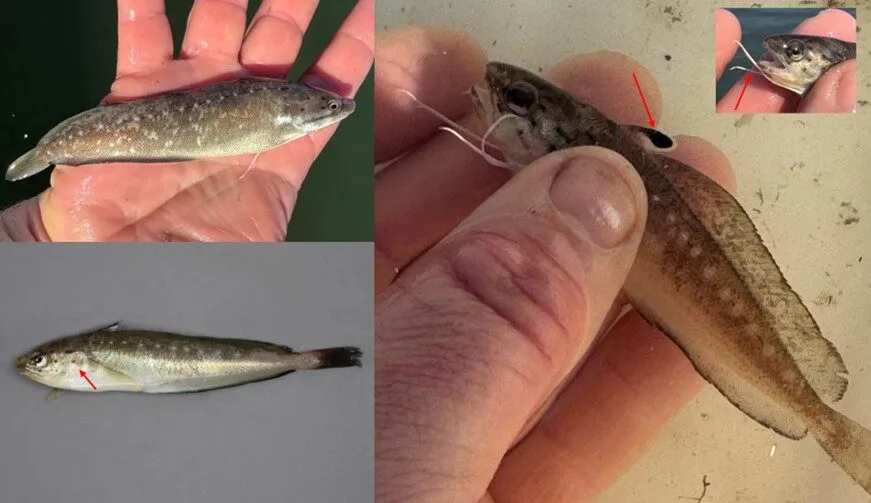
Many of the fish we encounter on our monthly trawls rely on Georgia’s estuaries year-round for food and shelter. For others, our estuaries might only provide seasonal refuge. As water temperatures continue to drop and we head into the winter months one such fish I look forward to encountering is the spotted hake (Urophycis regia).
Spotted hake inhabit coastal waters from New England down through the Gulf of America. In Georgia’s estuaries, they are primarily a cool‑season visitor rather than a year‑round resident. Historical ecological surveys for the Georgia coast describe spotted hake as common in estuaries from about January through May, with most of the population occurring offshore for the rest of the year. Spotted hake are slender, soft-bodied fish that are brownish in color with a pale belly. They have a dark lateral line accented by small pale spots, and a dark blotch on its gill cover, giving it a subtly patterned look that stands out in good light. Their skin is coated with mucus and small scales that make the fish extremely slippery to handle. They can be distinguished from the similar looking southern hake (Urophycis floridana) that also inhabit local waters by the presence of an ocellated spot on their first dorsal fin.
Like many hakes, spotted hake also sport a small barbel on its chin and long, feeler-like pelvic fin rays that help it “feel” along the bottom for food. Spotted hake favor soft bottoms such as mud, sand, and mixed shell where they can cruise just above the seafloor or rest directly on it. Because they are mostly nocturnal and oriented to the bottom, they are more likely to show up in research gear and commercial trawls than in typical hook-and-line catches, which contributes to their low public profile.
Fun Fact: Spotted hake are considered a mid-level predators and feed on a variety of crustaceans such as shrimp and crab as well as polychaete worms and other invertebrates and smaller fishes.