
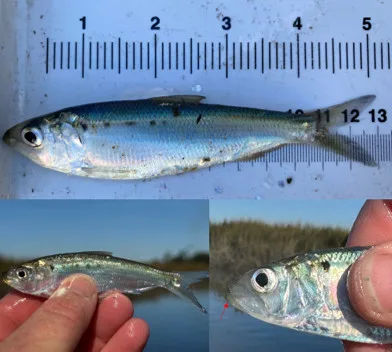
We recently caught several hickory shad (Alosa mediocris) during our monthly sampling, and it reminded me that these silvery members of the herring family have quite an interesting life history. The hickory shad is known as an anadromous species. They spend most of their lives in the Atlantic Ocean but return to freshwater to spawn, a behavior documented across their range from Florida to Maine. According to the Georgia Department of Natural Resources the shad spawning run in the state usually begins in January and goes through May. During this period, hickory shad and their larger cousin the American shad are targeted by commercial and recreational fishermen, particularly in the Altamaha and Savannah Rivers.
Spawning activity occurs in freshwater habitats such as creeks, flooded swamps, sloughs and other backwater tributaries. Larvae and small juvenile hickory shad leave these freshwater areas for tidal-freshwater and estuarine waters. As they continue to grow, they will then migrate from these estuarine nurseries to the ocean from summer to early fall. Little is known about the oceanic stage of the hickory shad’s life history, but adults are thought to live up to six to ten years and can reach up to two feet in length.
Hickory shad have elongated, laterally compressed bodies and a prominent lower jaw, which extends beyond their snout. A row of dark spots is present on its sides, and their coloration shifts from green‑gray on top to bright silver along the sides, an adaptation that helps them navigate living both fresh and saltwater environments. Hickory shad also feed on variety of prey throughout their life cycle including plankton, aquatic insects, small crabs and shrimp, squid and even fish!